
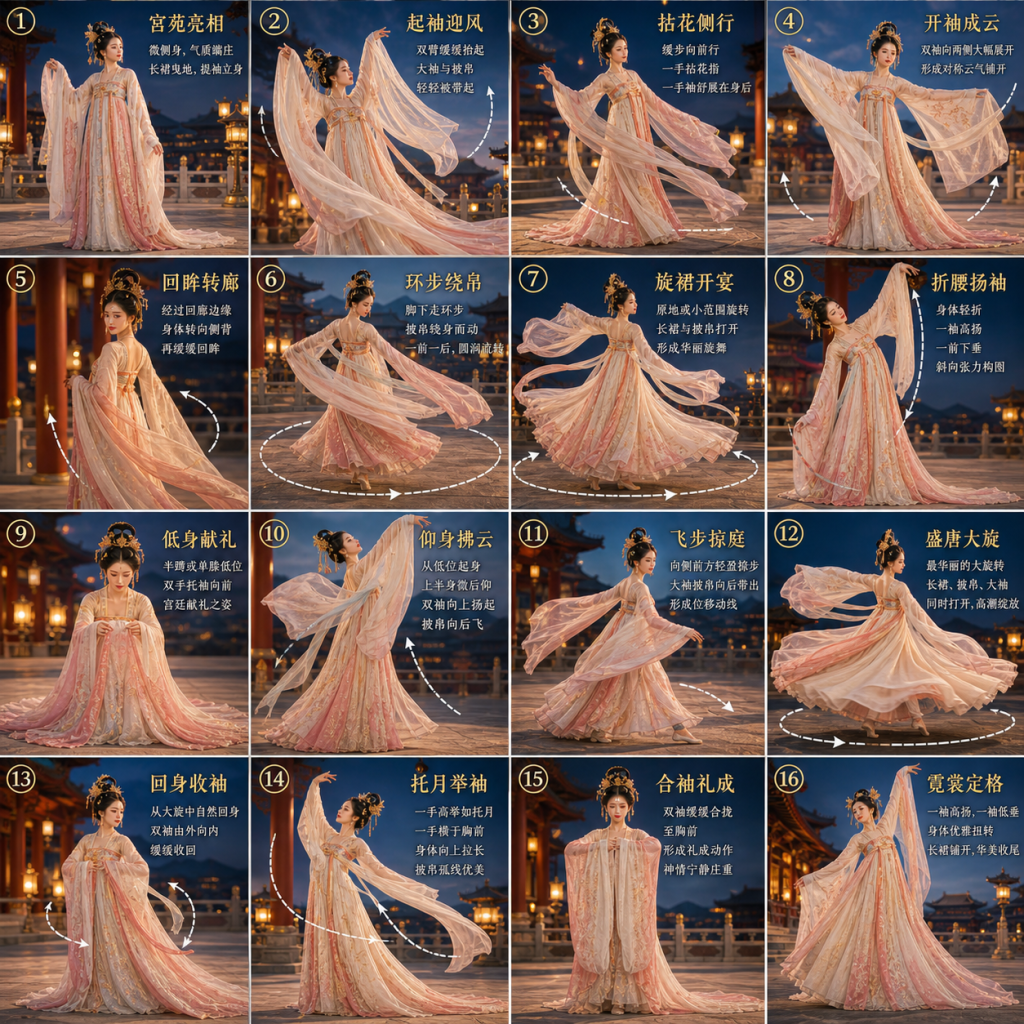
Step 1 | First, Generate a 16-Panel Choreography Storyboard
Begin by using ChatGPT to plan a sequence of 16 key action frames for a “Han-Tang Court Dance / Dance of the Rainbow Skirts and Feathered Robes.”
The focus here is not merely on generating images of beautiful women, but rather on first deconstructing the dance into its core components:
Action nodes, costume dynamics, scene atmosphere, and cinematic framing.
Of course, you can also swap out the theme for other dance styles—such as Dunhuang “Flying Apsaras” dances, “New Chinese” style, Water Sleeve dances, Street Dance battles, and so on.
Prompt:
Please create a highly polished, high-resolution “Han-Tang Court Dance / Dance of the Rainbow Skirts and Feathered Robes — 16-Panel Storyboard.”
【Overall Concept】
This is neither a standard “ancient-style” portrait series nor a simple dance tutorial graphic; instead, it is a highly refined storyboard poster that synthesizes “Han-Tang Court Dance,” the “Dance of the Rainbow Skirts and Feathered Robes,” “realistic palace architecture,” a “cinematic storyboard aesthetic,” and a “16-step choreographic sequence.”
The overall presentation should resemble a complete choreography for a High Tang Dynasty court dance, broken down into 16 key frames. Each panel must be distinct and self-contained, yet possess a sense of continuous flow, making it suitable for subsequent use in video generation.
【Scene Setting】
No stages. No empty black backgrounds. No modern photography studios.
The setting must be a realistic, three-dimensional, and exquisite High Tang Dynasty palace environment that authentically captures the aesthetic spirit of the Han and Tang eras:
- The “golden-blue hour” at dusk, just as the palace lanterns are being lit.
- Vermilion palace pillars.
- Golden palace lanterns.
- Palace corridors / The courtyard outside the main hall.
- Stone steps, railings, and sheer fabric drapery.
- Layered palace structures and deep vistas of the royal grounds visible in the distance.
- The space must feature distinct foreground, mid-ground, and background layers, conveying a genuine sense of spatial depth.
- The overall atmosphere should be opulent, luminous, and strongly evocative of a prosperous golden age; avoid any murky darkness, visual muddiness, or color blotches.
【Character Setting】
The protagonist is a young Chinese female dancer embodying the temperament of a High Tang court performer—dignified, resplendent, graceful, and poised.
Across all 16 panels, she must maintain the exact same facial features, character identity, demeanor, and costume ensemble; each panel should not look as though it features a different person. 【Attire & Styling】
The costume is inspired by Han and Tang Dynasty court dance attire / the “Rainbow Skirt and Feathered Robe” style:
- High-waisted, floor-length skirt
- Wide, flowing sleeves
- Light, sheer silk sash (Pibo)
- Exquisite hair bun/coiffure
- Gold hair ornaments and Buyao (dangling hairpins)
- Minimal Huadian (forehead ornamentation) or Tang-style makeup aesthetic
- The skirt hem, sash, and sleeves must exhibit realistic, dynamic movement.
Recommended Color Palette: - Rouge Pink
- Ivory White
- Champagne Gold
- Pale Stone Blue
The overall aesthetic should be magnificent yet refined—luxurious without being gaudy.
【Layout Requirements】
- The visual layout must utilize a 4×4 grid structure (16 panels).
- Each panel must be clearly numbered from 1 to 16.
- Each panel must feature a Chinese title describing the action.
- Each panel may include concise Chinese descriptions or brief instructional notes.
- Each panel should function as a distinct, independent camera shot.
- Appropriately incorporate directional arrows or motion lines to enhance the storyboard feel.
- The overall presentation must be clear, neat, and comprehensive, yet avoid becoming overly cluttered.
- The resolution must be extremely high-definition; lines must be crisp, and both figures and backgrounds must be sharp—avoid any blurriness, visual “noise,” or color artifacts.
【Action Sequence / Storyboard Order】
- Grand Entrance (Palace Courtyard)
The dancer stands at the center of the palace courtyard, body slightly angled to the side; her long skirt trails along the ground as she gently lifts one wide sleeve while allowing the other to hang naturally, establishing the majestic aura of the High Tang era. - Lifting Sleeves to the Breeze
Both arms rise slowly; the wide sleeves and silk sash are gently lifted upward, evoking the moment when the music first begins. - Strolling with a Blossoming Hand
The dancer walks forward at a measured pace; one hand forms a “pinching flower” or “orchid” gesture, while the wide sleeve of the other arm trails gracefully behind her—a movement of pure elegance. - Sleeves Unfurling Like Clouds
Both sleeves are dramatically extended outward to the sides, creating a symmetrical and magnificent open composition that resembles clouds spreading across the sky. - Glancing Back in the Corridor
The dancer passes by a palace pillar or along the edge of a covered walkway; she turns her body to face partially away from the viewer, then slowly turns her head back to cast a lingering glance. - Circling Steps and Flowing Sash
The dancer executes a circular stepping pattern with her feet; the silk sash winds around her body, tracing a fluid path, while her arms move in a balanced front-and-back rhythm—a movement characterized by its smooth, rounded grace. 7. Swirling Skirt: The Banquet Begins
Spin in place or within a small radius; the long skirt and flowing sashes (pibai) flare open, creating a magnificent, swirling dance. - Bending Waist, Lifting Sleeve
The body bends gently; one sleeve is lifted high while the other hangs low, creating a dynamic diagonal composition. - Low Bow: The Offering
Assume a semi-crouched or kneeling position; extend both hands—cupping the sleeves—forward in a gesture resembling a courtly tribute, evoking a sense of ritual and ceremony. - Arching Back: Brushing the Clouds
Rise from a low position while arching the upper body slightly backward; both sleeves sweep upward as the sashes trail behind—a movement that is visually stunning yet physically achievable for a human dancer. - Flying Steps: Gliding Across the Courtyard
Execute a light, gliding step diagonally forward; the wide sleeves and sashes trail behind, tracing a dynamic line of movement. - Grand Tang Dynasty Spin
The most spectacular of the spins: the long skirt, sashes, and wide sleeves flare open simultaneously—marking one of the most powerful climaxes of the entire sequence. - Turning Back: Gathering the Sleeves
Naturally turn back from the grand spin; slowly draw both sleeves inward from an outward extension, transitioning the movement from expansive openness to graceful containment. - Cupping the Moon: Lifting the Sleeve
Lift one hand high as if cradling the moon, while holding the other horizontally across the chest; the body elongates upward as the sashes form an elegant arc at the dancer’s side, creating a strong sense of ritual solemnity. - Joining Sleeves: The Ceremony Concludes
Slowly bring both sleeves together in front of the chest to signify the formal conclusion of the ceremony, maintaining a serene and dignified expression. - Nishang: The Final Pose
The grand finale: one sleeve remains lifted high while the other hangs low; the body executes an elegant twist as the long skirt spreads out, bringing the sequence to a dignified and magnificent close.
【Key Requirements】
- Must strongly convey a sense of realistic spatial depth and historical authenticity.
- Must maintain visual consistency regarding the same dancer throughout the sequence.
- Must feature fully dynamic motion for the wide sleeves, flowing sashes, and long skirt.
- Must be suitable for use as visual storyboard references for subsequent video production.
- Each individual frame/pose must be distinctly different, avoiding excessive repetition.
- The overall visual aesthetic must be magnificent, graceful, crisp, and luminous.
- Avoid overly dark or murky visuals; avoid visual “noise,” blurriness, color banding, or a cheap, kitschy “faux-ancient” aesthetic.
Step 2 | Feed the 16-Panel Grid to Seedance to Generate the Video
Upload the 16-panel storyboard grid generated in Step 1 to Seedance, then use video prompts to instruct the AI:
Execute the sequence in the order of panels 1 through 16;
Each panel serves as a key action node;
The camera work must include push-ins, lateral tracking, circling shots, and highlight sequences;
The costumes—specifically the wide sleeves, flowing sashes, and long skirts—must exhibit realistic, dynamic movement.
Prompt:
Please generate a highly polished video of a “Han-Tang Court Dance / Dance of the Rainbow Skirts and Feathered Robes,” based on the 16-panel reference grid I have provided.
Core Requirements:
Generate the sequence strictly in the order of Panel 1 through Panel 16. This is not a stage performance, nor is it a Xianxia (immortal-hero) special effects showcase; rather, it depicts an adult Chinese female dancer performing a magnificent, dignified, and fluid court dance within a realistic, three-dimensional setting of a High Tang Dynasty palace complex. The overall aesthetic should resemble a court dance sequence found in a feature film, emphasizing the authentic flow of the wide sleeves, flowing sashes, and long skirts, as well as the refined ceremonial atmosphere of the High Tang era.
Character Design:
The same adult Chinese female dancer must be depicted throughout the entire video, maintaining the exact same facial features and styling from start to finish. The costume should be authentic Han-Tang court attire: a high-waisted long skirt, wide sleeves, sheer flowing sashes, an elaborate hair bun, and gold hair ornaments. The color palette should be dominated by rouge-pink, ivory-white, champagne-gold, and pale stone-blue.
Scene Setting:
A realistic High Tang Dynasty palace complex / court corridor / courtyard situated outside a grand hall. The time of day is the “golden-blue hour” at dusk, just as the palace lanterns are being lit. The environment should feature vermilion palace pillars, golden lanterns, layered palace structures, railings, stone steps, sheer drapery, and deep background vistas of the distant palace grounds. The spatial composition must include distinct foreground, mid-ground, and background layers; it should feel realistic, airy, and beautiful—avoiding any dark, oppressive, or claustrophobic visuals.
Camera Requirements:
The camera work must be stable and elegant, incorporating slow push-ins, lateral tracking shots, subtle circling movements, and low-angle perspectives. Avoid shaky camera movements or rapid cuts. For the majority of the video, the dancer’s full body should be visible to clearly showcase the flowing motion of the wide sleeves, sashes, and skirt hem. Panel 12 marks the climax of the entire sequence, featuring a full 360-degree circling shot around the dancer. Strict Adherence Required: The setting must maintain stability and consistency; avoid any visual discontinuities or elements that defy the laws of the physical world. The dancer’s movements must be natural and fluid. No subtitles, symbols, or other graphic overlays are permitted. The background music (BGM) should be grand and atmospheric. The visuals must be seamless; the entire sequence must be filmed as a single continuous take, with no editing cuts allowed.
Storyboarding:
Shot 1: Palace Courtyard Reveal — The dancer stands center-stage in the palace courtyard, turned slightly to the side, her long gown trailing along the ground; the camera slowly pushes in.
Shot 2: Sleeves Catching the Wind — Both arms rise slowly; the voluminous sleeves and flowing silk streamers (pibo) are gently lifted by the movement; the camera pushes in slightly closer.
Shot 3: Holding a Flower, Moving Sideways — The dancer walks forward with measured steps, holding a flower in one hand while extending the voluminous sleeve of the other arm; the camera tracks horizontally alongside her.
Shot 4: Sleeves Unfurling Like Clouds — Both sleeves spread wide to the sides, creating a symmetrical visual composition; the camera executes a partial orbital movement around her.
Shot 5: A Glance Back at the Corridor — The dancer passes a palace column, turns slightly to look back over her shoulder; the camera shifts gently to follow her gaze.
Shot 6: Circling Steps, Silk Streamers Entwining — The dancer executes circling footwork as the silk streamers wrap around her body; the camera performs a subtle orbital movement.
Shot 7: Spinning Skirt, The Grand Opening — The dancer spins gracefully, causing her long gown and silk streamers to flare outward; the camera orbits approximately 180 degrees around her.
Shot 8: Bending at the Waist, Lifting a Sleeve — The dancer’s body bends slightly at the waist, with one sleeve raised high and the other hanging low; the camera adopts a slightly low-angle perspective.
Shot 9: Low Bow of Offering — The dancer assumes a low stance (either a half-crouch or kneeling on one knee), extending her hands—cupping the sleeves—forward in a gesture of offering; the camera maintains a low angle and pushes in slowly.
Shot 10: Arcing Back, Brushing the Clouds — Rising from the low stance, the dancer leans her upper body slightly backward as both sleeves sweep upward; the camera tilts upward in sync with her movement.
Shot 11: Gliding Steps Across the Courtyard — The dancer executes a series of light, gliding steps—movements that are physically realistic and achievable—as the camera tracks horizontally alongside her.
Shot 12: The Grand Tang Dynasty Spin — The dancer executes her most magnificent, grand spin, causing her long gown, silk streamers, and voluminous sleeves to flare open simultaneously; the camera performs a full 360-degree orbital movement around her.
Shot 13: Turning Back, Gathering the Sleeves — Naturally recovering from the grand spin, the dancer draws both sleeves inward from their outward extension; the camera follows her movement gently. Shot 14: “Cradling the Moon”—one arm is raised high as if cradling the moon, while the other rests horizontally across the chest; the camera slowly pushes in.
Shot 15: “Ceremonial Closure”—both sleeves slowly draw together in front of the chest; the movement is solemn and dignified, and the camera holds briefly.
Shot 16: “Final Tableau”—a definitive freeze-frame pose: one sleeve sweeps upward, the other hangs low, and the long skirt spreads out; the camera pulls back slightly to conclude the sequence.
Action Requirements:
All movements must be physically achievable by a real human dancer. Avoid levitation, flying effects, or unrealistic, exaggerated aerial acrobatics. The primary focus should be on conveying the grace and dignity of court dance—specifically the unfurling of wide sleeves, the flowing motion of silk sashes, the swirling of long skirts, and the aesthetic beauty of ceremonial ritual and music.
Negative Constraints:
Do not include stage backdrops, plain black backgrounds, Xianxia (immortal hero) special effects, or magical lighting effects. Avoid character levitation, shaky camera work, rapid cuts, visual muddiness, color banding, or blurring.
Step 3 | Simple Post-Processing and Final Export
Once the video has been generated, you can import it into video editing software to perform some basic optimizations:
Enhance clarity, adjust contrast and color, trim out any unstable segments, add suitable background music, and finally, export the finished video.
The key to this workflow is as follows: first, use a 16-panel grid to establish the action storyboard, and then use the video generation model to create the footage based on that storyboard.